Taking it down
When the season turns
Webbing dies slowly and invisibly. Twenty minutes in autumn buys you another summer.
Take it down before the first hard frost
A strap left tensioned around a trunk all winter does two bad things at once: it grinds against wet bark, and it stays damp. Both shorten its life, and neither is visible until the day it matters. Release the ratchets, unthread the webbing and bring it in.
Dry it properly, then coil it loose
Hang the straps over a rail indoors until they are dry all the way through — polyester feels dry long before it is. Coil loosely, never folded on the same crease, and keep them out of direct sun. Ultraviolet is what actually kills webbing.
Check the steel while it is in your hands
Run a thumb over every carabiner gate and every buckle. You are looking for grit in the mechanism and for any burr on an edge that touches webbing. A drop of light oil on the ratchet pawl, a wipe, and it goes back in the bag.
Store it where you will find it
Ours lives in its drawstring pack on a shelf in the garage, with the carabiners in a bag of their own so they do not chew the straps. In March it takes ten minutes to be back up, which is the entire reason it gets put up at all.
What goes up between the anchors
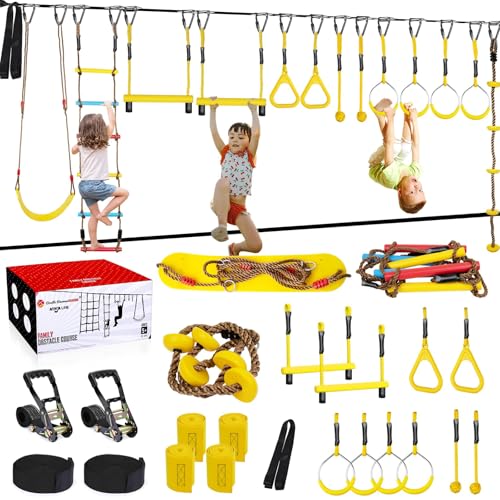
The 14-Station Line, 2x65 ft
Our long run: two 65-foot straps and fourteen places to hang, swing or haul yourself up.
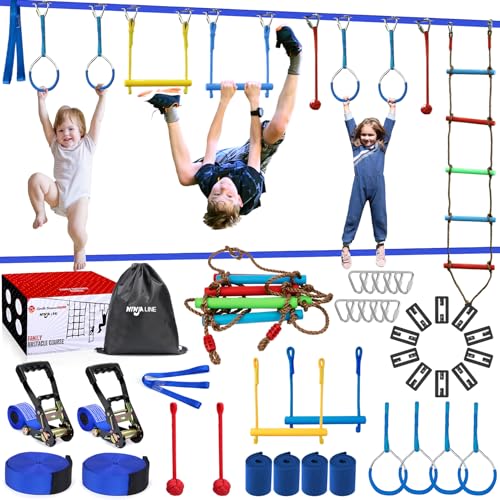
The 10-Station Line, 2x56 ft
Ten obstacles on two 56-foot straps — the kit most yards actually have room for.
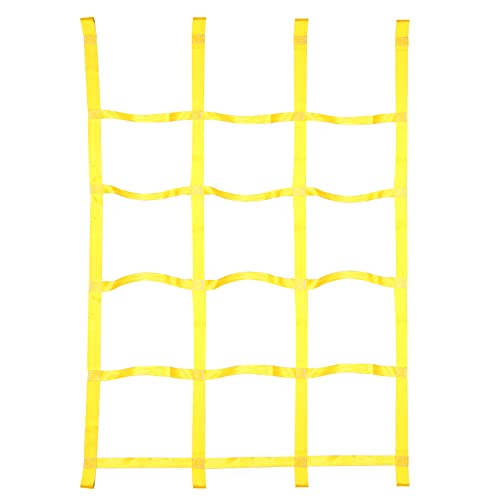
Climbing Cargo Net and Rope Ladder
A yellow webbing net that turns any beam, branch or line into a climb.