Before you buy anything
Picking your two anchors for a backyard ninja warrior obstacle course
Where the line goes decides how good the course is. Here is how we choose a span.
Start with the gap, not the kit
A backyard ninja warrior obstacle course is only ever as good as the two things holding it up. Before you choose a kit, walk the backyard and find the longest clear span you have. Thirty feet is plenty; sixty is luxury. Measure trunk to trunk, then look up and check there is nothing dead overhead, because that is the part people skip. Most backyard ninja courses we are sent photographs of went wrong right here: somebody bought first, measured second, and ended up running the ninja line at a diagonal across a flower bed.
What makes a trunk an anchor
We ask for a living trunk at least twelve inches across, with no rot at the base and no heavy limb hanging over the run. Two healthy trees beat any post you can set yourself. Where trees are missing, 4x4 posts in concrete work, and so do the uprights of a solid swing frame — the same timber people use to build permanent backyard rigs. A fence panel is not an anchor. A tensioned line pulls sideways with several times the weight of the kids hanging on it, and fence posts are set to stand up, not to be pulled over. Home-welded ninja rigs fail in the same place: the frame is strong enough to hang from and nowhere near stiff enough to be hauled on.
Height, sag and the fall zone
Hang the top strap so the lowest obstacle sits a little above the reach of the child using it, then add for sag: a loaded line drops several inches in the middle, and the monkey bars drop with it. Under the whole run you want grass, bark or mulch and nothing else — no paving, no roots, no garden edging. Pace out the space at both ends too, because a swing carries a child further than it looks, and the swing is the one obstacle every ninja on the line wants a second go at.
Laying out a backyard ninja warrior obstacle course
Now the fun part. Clip the climbing pieces where the ground is kindest, set the monkey bars in the middle where the line rides highest, and build the run as three acts: an easy start, a grip challenge, a finish they can reach. Most backyard ninja courses fail because every obstacle is the same difficulty, and the feeling of an obstacle course is all in the change of pace. Bolted rigs have the same problem with a drill attached to the fix; on a strap you slide a carabiner and the ninja warrior run is a different course before anyone has finished arguing about it. That is the whole case for webbing over hand-built rigs: backyard ninja courses made of scaffold and timber are set the day you build them, and a strap is never set at all. Keep the climbing low at the start for small kids, keep the bars high for the ones with reach, and let them build the rest themselves.
Small gardens, short seasons and the training question
A compact backyard is not a lost cause. A short ninja line fully loaded beats a long one half empty — set the obstacles closer and accept that the run is a sprint. Permanent ninja warrior rigs need foundations, planning and a weekend to build; a strap needs ten minutes and a ratchet, which is also why ours comes down in November. Webbing that spends a winter tensioned round a wet trunk does not get a second summer. And none of this is training equipment in the serious sense: children do not do training, they do fun, repeatedly, until their grip is unreasonable. Real ninja warrior training is just climbing, swinging and hanging about on bars with no adult counting the sets, which is exactly what a backyard ninja course is for.
The elements, and what a compact yard really costs you
Strip any backyard ninja course back and you get four elements: something to climb, something to hang from, something that swings and something that wobbles. Every design decision we make is about how those four elements are spaced, not about how many pieces come in the bag. A fully loaded compact run has all four within thirty feet; a sixty-foot run with the monkey bars at one end and nothing else has one. The feeling of a good course is continuous — hand leaves one thing, hand finds the next — and that feeling is built out of spacing, not out of space.
Is it a workout, or is it play?
Both, as long as nobody says the word fitness out loud. A kid who crosses fourteen stations has done a grip workout no fitness class would get out of them, and they think they have been playing ninja. That is the honest design brief for everything we build: make the fun obvious and let the fitness be a side effect. The rigs that fail are the ones built to look like gym equipment — they get used hard for a fortnight and then the kids go back to the swing.
What goes up between the anchors
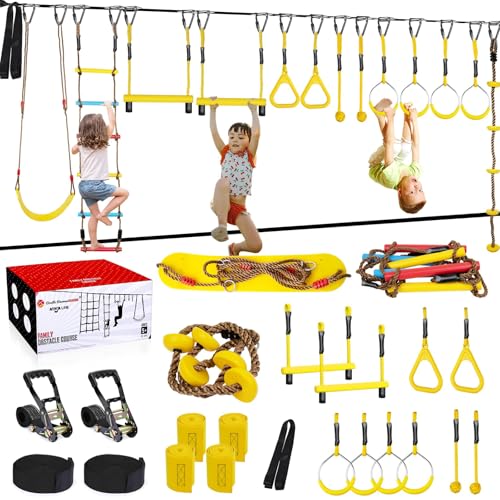
The 14-Station Line, 2x65 ft
Our long run: two 65-foot straps and fourteen places to hang, swing or haul yourself up.
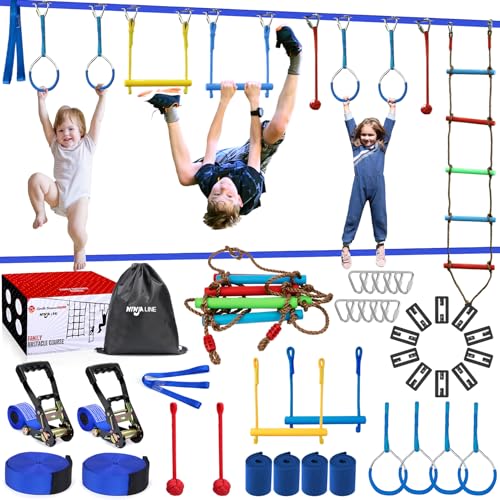
The 10-Station Line, 2x56 ft
Ten obstacles on two 56-foot straps — the kit most yards actually have room for.
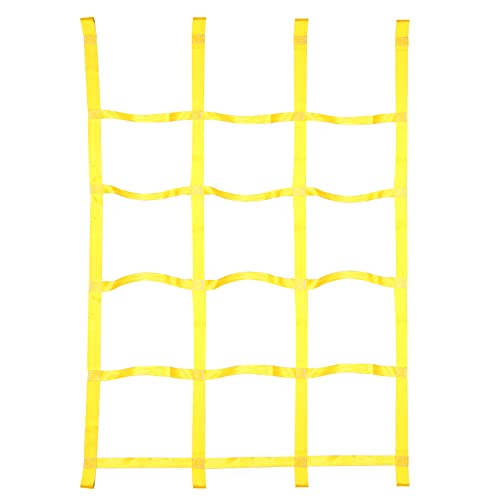
Climbing Cargo Net and Rope Ladder
A yellow webbing net that turns any beam, branch or line into a climb.